
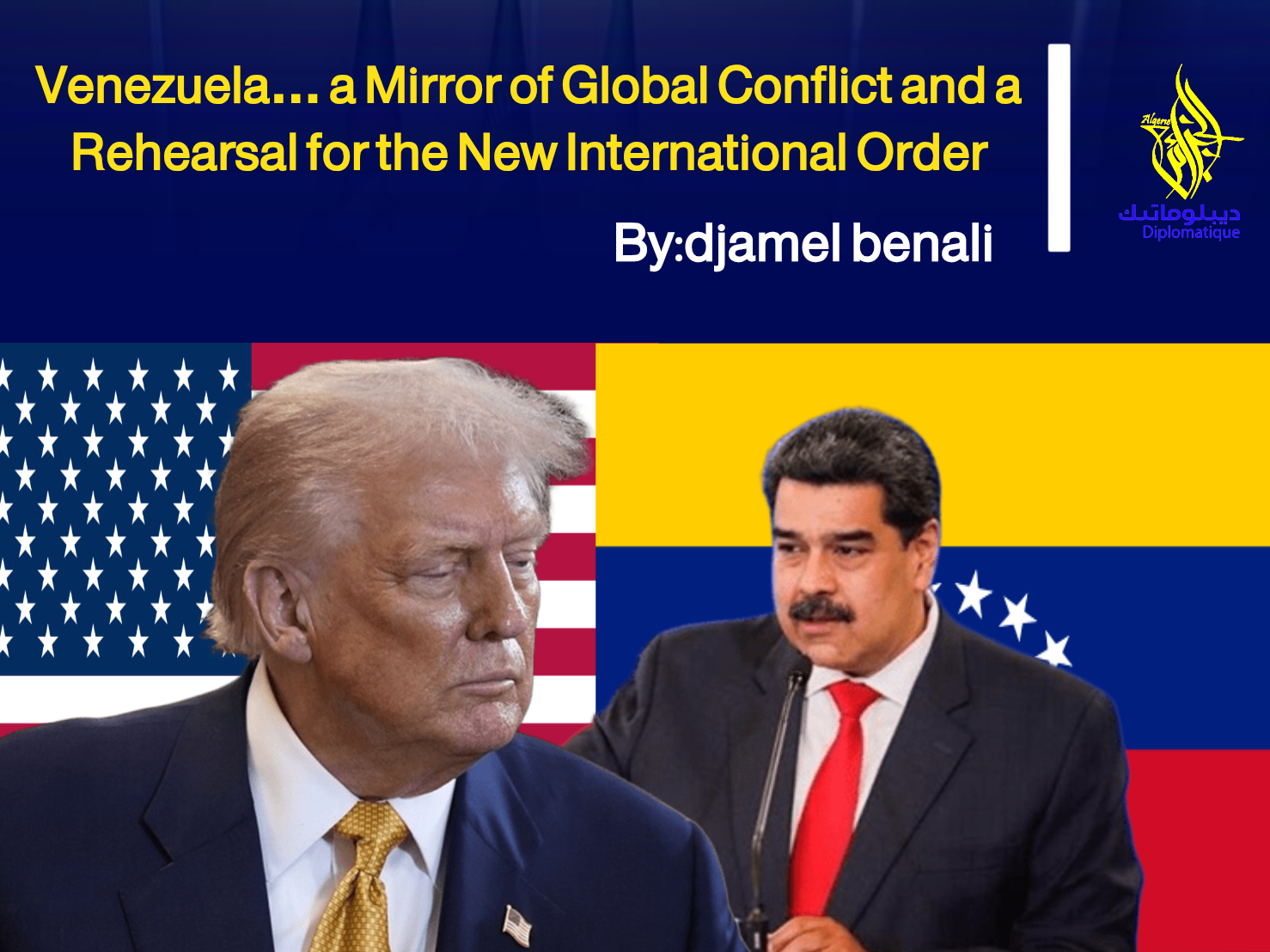
By:djamel benali
What has happened in Venezuela is no longer an internal political crisis, nor a dispute over the legitimacy of power or election results. It has turned into a revealing event that exposes the nature of the international system in its current moment. Venezuela today is not a country merely experiencing turmoil; it is a harsh testing ground for the rules of power, the limits of sovereignty, and the future of international relations in a world governed by naked interests.
First: From an internal crisis to the breaking of international order rules
When a conflict reaches the point of storming sovereign institutions, bombing official headquarters, and arresting a head of state inside his own palace, all the doctrines that have governed international relations since the end of the Second World War have been crossed. This is no longer political pressure, economic blockade, or indirect influence, but a blatant intervention that redefines the very concept of the state. What happened in Venezuela shows that sovereignty is no longer a red line, and that the head of state no longer enjoys political or legal immunity when his position clashes with the interests of major powers.
Second: Venezuela… the state that paid the price for its decision
Venezuela was not forgiven for possessing one of the largest oil reserves in the world, nor was it forgiven, even more, for attempting—however minimally—to manage its sovereign decision outside American tutelage. For years, Caracas was placed under a suffocating economic siege, stripped of its financial tools, vilified by the media, and confronted with opposition movements lacking a unifying national horizon. What is new is the shift from a policy of slow subjugation to a logic of violent resolution, carrying deterrent messages to other states considering deviating from the path drawn for them.
Third: Bombing headquarters… when the idea of the state is targeted
Bombing official and security headquarters does not merely mean overthrowing a regime; it is a direct assault on the concept of the nation-state itself. It is an explicit declaration that the institutional structures of undesirable states can be dismantled by force, and that legitimacy is no longer derived from within or from international law, but from the balance of power. This development signals a dangerous shift from containable political conflicts to open wars of sovereignty governed by no rules and restrained by no institutions.
Fourth: The arrest of a head of state… a precedent that terrifies the world
Arresting a head of state and forcibly transferring him outside his country represents the most dangerous aspect of the scene. We are facing a precedent that pushes international relations into an era of legalized political kidnapping, where heads of state are treated as targets rather than sovereign actors. If this step becomes entrenched, it means the undeclared end of international law and opens the door to a new logic: whoever is not protected by strong alliances and does not possess deterrent tools becomes a legitimate target.
Fifth: Venezuela as an arena of conflict between two worlds
What happened in Venezuela cannot be separated from the broader global struggle between a Western system seeking to preserve its dominance at any cost, even if that requires breaking the rules it itself established, and rising international powers that see in these events a direct threat to them and to the very concept of international balance. Russia and China, along with other powers, view Venezuela, Cuba, and Colombia as a forward line of defense for the idea of sovereignty, and any international silence toward this model means that others may be next.
Sixth: Features of the international order rising from the ashes
Through Venezuela, the contours of the new world order become clear: a world without moral masks, where values are replaced by interests; the politicization of military force and the economy, where sanctions and bombing are two sides of the same coin; the retreat of international institutions to the role of helpless spectators; and the acceleration of global polarization into opposing blocs. We are not facing a more just system, but one more honest about its violence.
Conclusion: Venezuela is not an exception… but a warning
Venezuela is not the end of the story, but its beginning. What happened there is a clear message to all countries of the Global South, and to anyone who believes that neutrality or rhetoric alone can protect sovereignty. The world is entering a phase where politics is managed by force rather than law, by deterrence rather than statements. Those who fail to read Venezuela carefully today may find themselves tomorrow at the heart of the same scene. Venezuela is not merely a crisis; it is the mirror of a global order taking shape without mercy and without illusions.