
BY :DJAMEL BENALI
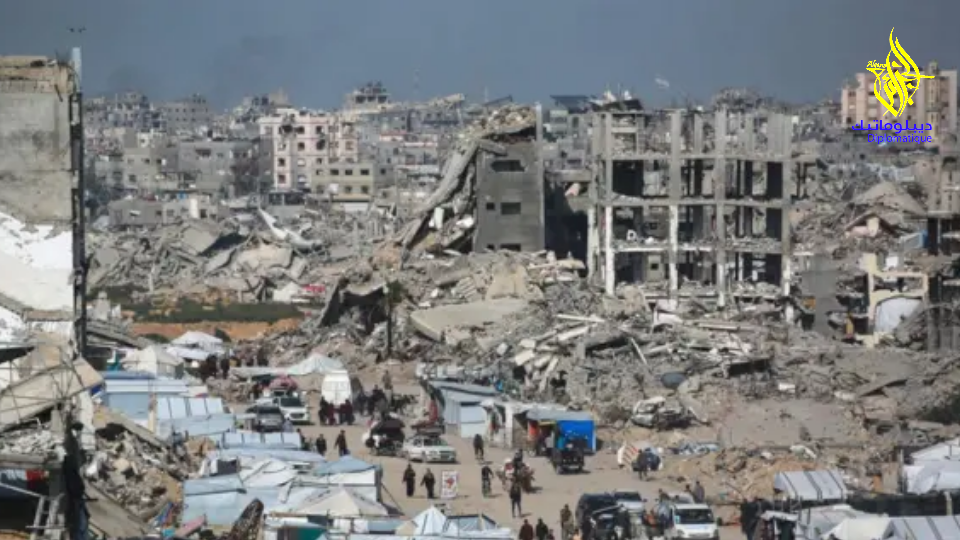
declared objective is the reconstruction of Gaza and the opening of a humanitarian horizon after one of the most devastating wars in the region’s modern history. On the surface, the project appears to be a belated response to a global conscience shaken by images of death, destruction, and human suffering. Yet a closer examination of its background, its human composition, and its political underpinnings reveals that this initiative goes far beyond reconstruction and enters the realm of reshaping power balances in the region and the world.
The real source of concern does not lie in the slogans, but in the figures associated with the project. When Jared Kushner, the son-in-law of former US President Donald Trump, appears alongside influential American figures drawn from finance, real estate, and geopolitical investment circles, political memory cannot remain neutral. Kushner is not a marginal name; he was one of the main architects of the so-called Deal of the Century, a project that sought to liquidate the Palestinian cause through transactional logic rather than rights-based justice. His presence in any framework claiming to pursue peace inevitably raises a fundamental question: are we witnessing a genuine humanitarian initiative, or a new attempt to subordinate politics to market logic?
In this context, Gaza is no longer viewed solely as a devastated territory in need of rebuilding, but as a testing ground for a new model of domination. Reconstruction is framed in the language of investment, opportunity, and redevelopment, rather than justice, reparations, and the right of peoples to self-determination. Who will fund the reconstruction? Who will supervise it? Who will decide the shape of the city, its priorities, and its future? And who will ultimately own the land after it has been rebuilt? These questions remain unanswered, deliberately left in a grey zone where humanitarian discourse blends with profit-seeking and peace merges with guardianship.
Even more alarming is the fact that this council is designed to operate outside the traditional frameworks of international legitimacy. It is neither accountable to the United Nations, nor bound by the resolutions of the General Assembly, nor subject to international legal oversight. It is a flexible, trans-institutional body that raises the banner of peace while functioning as a parallel, and potentially alternative, center of global decision-making to the UN Security Council, without even the limited constraints that bind the latter. If the Security Council has long been criticized for paralysis, bias, and veto-driven dominance, the proposed alternative carries an even greater risk: a global authority governed not by law, but by interests, and restrained not by international balance, but by the power of money and influence.
This development cannot be separated from the broader transformations of the global order. The decline of the authority of the United Nations, the fragmentation of the post–World War II international system, the rise of informal and opaque alliances, and the shift from geopolitics to geo-economics all point in one direction: a redefinition of power itself. Power is no longer confined to armies and weapons, but increasingly embedded in control over reconstruction, energy routes, strategic corridors, and the redrawing of maps under a soft humanitarian cover.
Gaza, in this sense, is not the sole objective, but the gateway. A gateway to reorganizing the Eastern Mediterranean, controlling strategic chokepoints, and reengineering the Arab region in line with the interests of specific powers. It is a conditional peace, one that may silence the guns without ending occupation, that may rebuild walls while stripping people of their right to sovereignty and decision-making. A peace negotiated in closed rooms, not around fair and inclusive negotiating tables.
The true danger lies in turning this model into a precedent. If it succeeds, it will open the door to the privatization of peace, the transformation of reconstruction into a systematic mechanism of plunder, and the redrawing of geostrategic maps without the consent of peoples and outside the framework of international law. At that point, we would no longer be facing a Peace Council, but rather a council of tutelage, or a council of plunder disguised in humanitarian language.
The world today stands at a decisive crossroads. Either the reconstruction of Gaza becomes an act of historical justice, conducted within a fair international legitimacy that places the Palestinian people at the center of decision-making, or it turns into a Trojan horse that drags the region and the world into an even more dangerous phase, where new global orders are forged atop the ruins of destroyed cities. The question that remains open, and painfully so, is this: is the world being reshaped from beneath the rubble of Gaza, without Gaza and its people?