
By:djamel benali
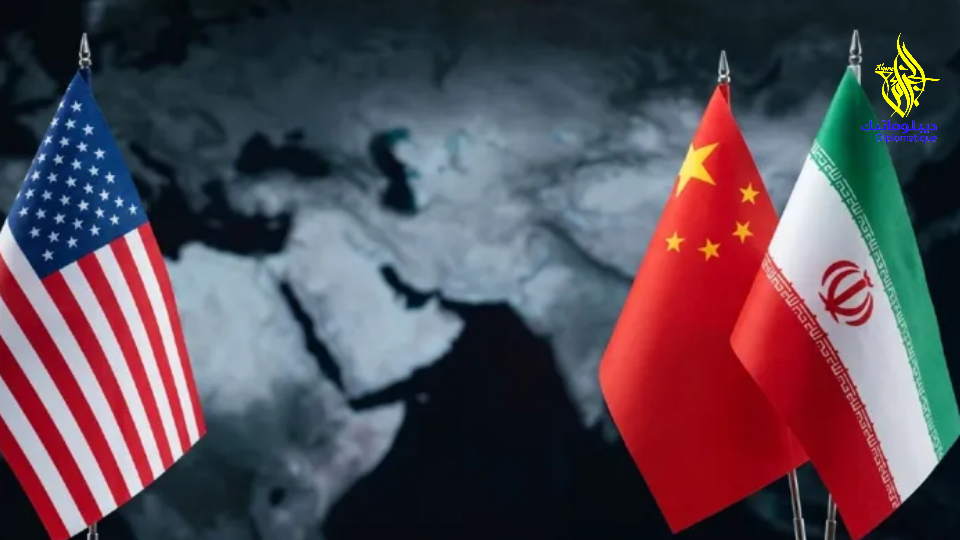
Oil is no longer merely a strategic commodity; it has become a geopolitical instrument used to reshape the balance of power in the international system. If Venezuela served as a testing ground for policies aimed at economically isolating energy producers, Iran today stands at the center of a broader confrontation that extends well beyond the Middle East. At the heart of this confrontation lies a larger objective: containing China.
China is the world’s largest energy importer and has remained one of the primary buyers of Iranian crude despite sanctions. For Beijing, Iranian oil represents two major advantages: competitive pricing and relative independence from Western-controlled financial and shipping systems. Securing diversified energy supplies is essential to sustaining China’s industrial expansion and global economic influence.
When the administration of Donald Trump launched its “maximum pressure” campaign against Iran, the declared goal focused on Tehran’s nuclear program and regional policies. However, beyond official justifications, the sanctions also had a strategic dimension. Restricting Iran’s oil exports indirectly targeted China’s energy security by limiting access to discounted crude outside Western oversight.
A similar pattern unfolded with Venezuela. Sanctions on Caracas severely weakened its oil sector, constraining another supplier capable of offering alternative flows to China. The recurring approach suggests a broader strategy: pressure energy-producing states that operate beyond Western influence in order to complicate China’s long-term strategic planning.
Energy security lies at the core of China’s global ambitions, particularly within the framework of its Belt and Road Initiative.
Iran occupies a crucial geographical position, overlooking the Strait of Hormuz — one of the most vital maritime chokepoints for global oil transit. Any escalation involving Iran heightens volatility in global markets, drives up prices, and increases transportation risks. Such instability disproportionately affects large import-dependent economies.
Escalation, whether through sanctions or military tension, thus carries implications that stretch far beyond bilateral disputes. Rising instability in the Gulf can disrupt global supply chains and create financial uncertainty. In this context, oil becomes both a strategic leverage point and a pressure mechanism within a wider geopolitical rivalry.
However, this strategy is not without risks. Iran possesses regional alliances and asymmetric deterrence capabilities. A broader confrontation could destabilize global energy flows in ways that harm not only China but also Western economies. Moreover, sustained pressure may accelerate deeper strategic cooperation between Iran, China, and other major powers, potentially contributing to the emergence of parallel economic and energy systems outside traditional Western frameworks.
Ultimately, the issue transcends Iran itself. It reflects a larger struggle over control of global energy arteries and the shape of the evolving world order. From Venezuela to Iran, the pattern appears consistent: constrain suppliers in order to influence the strategic calculations of the largest consumer. Whether this approach successfully limits China’s rise or instead hastens the fragmentation of the global energy system remains an open question.