
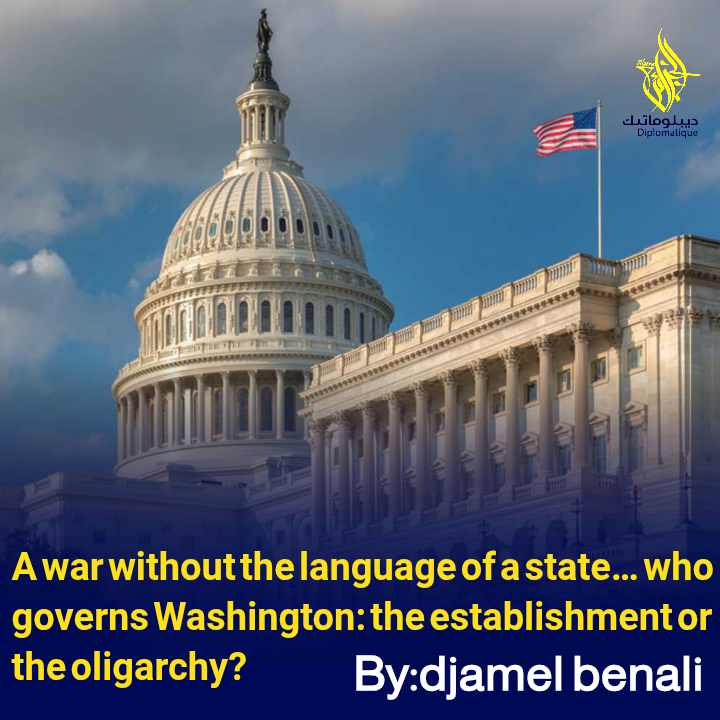
By:djamel benali
Amid an ongoing war with Iran, the most dangerous aspect of the situation is no longer the missiles as much as the language that precedes them. The language of threats, intimidation, and crude expressions repeatedly used by Donald Trump is no longer just a verbal slip, but has turned into a governing approach that reduces the state to a confrontational discourse and pushes the world toward the brink of explosion.
However, the question today is no longer only about this excess, but about who stands behind the decision-making. Do the traditional “establishment” institutions—Congress, the Pentagon, and the intelligence agencies—still hold the reins of balance? Or are we facing a deeper shift, where the “oligarchy” is advancing to occupy the real leadership position in Washington?
When the name Jared Kushner is placed at the heart of decision-making, he cannot be considered just an ordinary advisor. The man, coming from the world of finance and real estate, has become a key actor in sensitive الملفات, from the Middle East to international relations. Here the question arises: are we dealing with institutional diplomacy, or a diplomacy of interest networks?
This does not stop there. The rise of figures from the business and real estate world, such as Steve Witkoff, into circles of influence reinforces the impression that political decision-making is no longer reserved for statesmen, but has become open to those with financial power and personal connections. In this case, politics blends with business, and even wars become part of complex calculations that do not always follow the logic of the state.
This shift—if accurate—raises a profound dilemma: when institutions recede and private networks advance, who guarantees the stability of decision-making? And who draws the line between national interest and private interest?
On the other hand, what is known as the establishment in the United States seems to be in the position of a spectator, or at least unable to impose balance. The successive dismissals and shifting positions reflect an internal struggle that has not yet been resolved between the logic of the state and the logic of personal influence.
In this context, the statements of John Bolton take on a new dimension; they are no longer merely a description of a person, but an entry point to understanding a mode of governance based on personalization, and perhaps on alliances outside the traditional institutional framework.
Internationally, the marginalization of the United Nations and the inability of the Security Council to curb this trajectory reveal that the crisis has gone beyond Washington, becoming a crisis of the entire international system.
The most dangerous aspect of this moment is not only the war, but the way it is being managed: unrestrained rhetoric, unstable decision-making, and the possibility that the oligarchy—not institutions—is pulling the strings. When that happens, politics is no longer the art of managing crises, but turns into an open gamble.
Between the noise of threats and the silence of institutions, the question remains suspended: is there still a state in Washington, or has the state itself been reshaped by interests and influence that recognize nothing but power?