
By:djamel benali
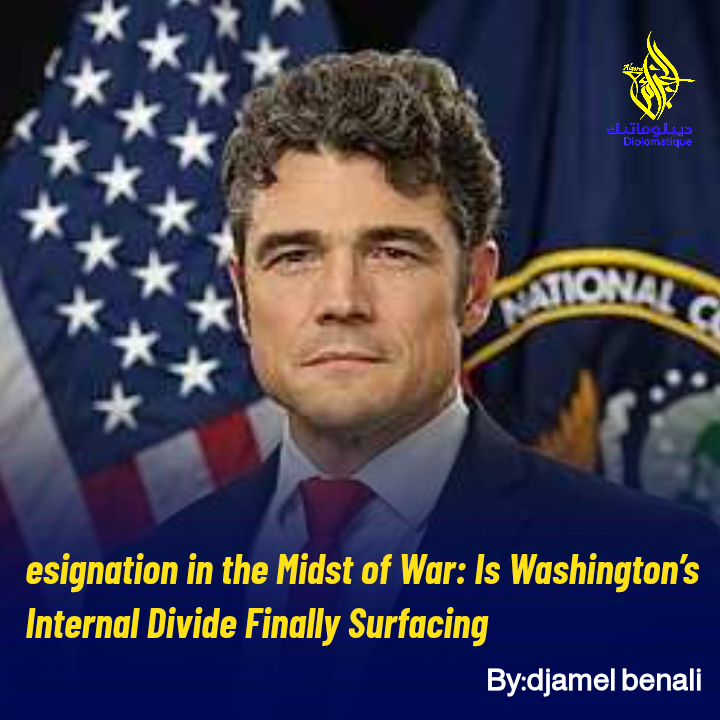
In a striking and highly consequential move, Joe Kent resigned as head of the U.S. Counterterrorism Center just two weeks after the outbreak of war with Iran. This was no routine resignation—it was a signal event that exposed deep fractures within the core of America’s national security decision-making.
When a senior counterterrorism official steps down in the middle of an active conflict, the implications are profound. It suggests not only disagreement, but potentially a fundamental breakdown in strategic consensus. At a time when unity is critical, such a departure raises serious concerns about internal coherence.
Joe Kent’s resignation raises a central question: is this merely a policy dispute, or evidence of a growing power struggle within the White House and the broader U.S. security establishment?
Current dynamics suggest something more serious than a simple disagreement. Washington appears increasingly divided between competing strategic camps: one advocating escalation and military dominance, another warning of uncontrollable consequences and long-term instability, and a third rejecting the premise of another costly foreign war altogether.
The war with Iran has become the focal point of this internal tension. Unlike previous conflicts, Iran represents a complex and deeply networked regional power, capable of asymmetric responses across multiple fronts. Any escalation risks triggering a broader, prolonged conflict with unpredictable consequences.
Perhaps the most pressing concern among security professionals is the risk of blowback. History has repeatedly shown that large-scale military interventions in volatile regions often generate new waves of extremism. From Iraq to Afghanistan, instability has proven to be fertile ground for the resurgence of terrorist threats.
Adding to the controversy is the characterization of the conflict by some voices within the United States as an “Israeli-American war.” This framing intensifies internal divisions by questioning whether U.S. actions are driven by its own strategic interests or influenced by alliance dynamics that may pull it into broader confrontations.
In this context, Joe Kent’s resignation should not be seen as an isolated incident, but potentially the first visible crack in a larger structural divide—one that could widen as the war progresses.
What is at stake is not only the outcome of a conflict abroad, but the integrity of decision-making at home. Great powers do not falter only on battlefields; they also weaken when internal divisions prevent them from acting with clarity and unity in moments of crisis.