Actualités
Diplomacy at the Iftar Table: Saudi Ambassador in Algiers Hosts Political and Media Figures in a Ram... The UAE and the Engineering of Systematic Chaos: Planting Discord, Looting Resources, and Destabiliz... Algérie/Royaume-Uni Un forum, une exposition et une rencontre à la Chambre des Lords pour dynamiser ... Déclaration de Son Excellence l'Ambassadeur Ben Jamaa Ammar devant le Conseil de sécurité Norway pleads for the entry of humanitarian aid into Gaza Visite du ministre de la Santé à Oum El Bouaghi : réponse rapide et action sur le terrain après l’in... Les échos positifs de la nomination du professeur Mohamed Seddik Aït Messaoudene comme ministre de l... La norvége condamne l'agression israélienne contre qatar Norway condemns the aggression against Qatar The Embassy of India in Algeria celebrates the 79th Independence Day of India Le Chargé d’Affaires de l’ambassade de France en Algérie convoqué au ministère des Affaires Etrangèr... La Norvège contribue à hauteur de 200 millions de couronnes norvégiennes à l'aide budgétaire à la Pa... Norway contributes NOK 200 million in budget support to Palestine Algerian Television Triumphs with Five Awards at the Arab Festival under Mohamed Baghali’s Leadershi... La télévision algérienne brille au Festival arabe et remporte cinq prix prestigieux sous la directio... Cour africaine des droits de l’Homme : la magistrate Chafika Bensaoula élue vice-présidente Sahara occidental: l'Algérie regrette le soutien du Royaume-Uni au prétendu plan d’autonomie marocai... Les officines françaises poursuivent la gestion des relations algéro-françaises par des fuites organ... Timor-Leste : le droit du peuple sahraoui à l'autodétermination réaffirmé avec force au séminaire an... «Peut-être»: Donald Trump Junior n'exclut pas de se présenter à la présidence un jour
Opinions et analyses

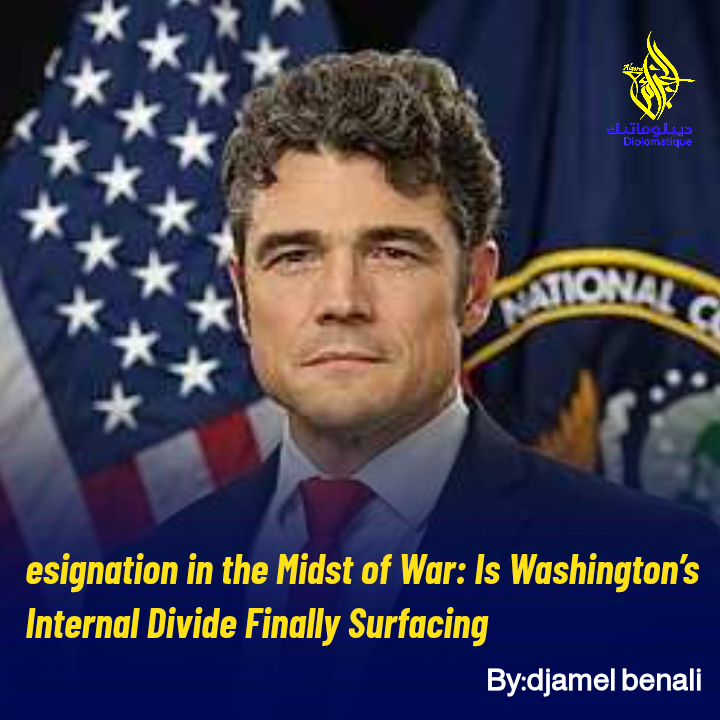
esignation in the Midst of War: Is Washington’s Internal Divide Finally Surfacing
By:djamel benali
In a striking and highly consequential move, Joe Kent resigned as head of the U.S. Counterterrorism Center just two weeks after the outbreak of war with Iran. This was no routine resignation—it was a signal event that exposed deep fractures within the core of America’s national security decision-making.

When a senior counterterrorism official steps down in the middle of an active conflict, the implications are profound. It suggests not only disagreement, but potentially a fundamental breakdown in strategic consensus. At a time when unity is critical, such a departure raises serious concerns about internal coherence.

Joe Kent’s resignation raises a central question: is this merely a policy dispute, or evidence of a growing power struggle within the White House and the broader U.S. security establishment?

Current dynamics suggest something more serious than a simple disagreement. Washington appears increasingly divided between competing strategic camps: one advocating escalation and military dominance, another warning of uncontrollable consequences and long-term instability, and a third rejecting the premise of another costly foreign war altogether.

The war with Iran has become the focal point of this internal tension. Unlike previous conflicts, Iran represents a complex and deeply networked regional power, capable of asymmetric responses across multiple fronts. Any escalation risks triggering a broader, prolonged conflict with unpredictable consequences.

Perhaps the most pressing concern among security professionals is the risk of blowback. History has repeatedly shown that large-scale military interventions in volatile regions often generate new waves of extremism. From Iraq to Afghanistan, instability has proven to be fertile ground for the resurgence of terrorist threats.

Adding to the controversy is the characterization of the conflict by some voices within the United States as an “Israeli-American war.” This framing intensifies internal divisions by questioning whether U.S. actions are driven by its own strategic interests or influenced by alliance dynamics that may pull it into broader confrontations.

In this context, Joe Kent’s resignation should not be seen as an isolated incident, but potentially the first visible crack in a larger structural divide—one that could widen as the war progresses.

What is at stake is not only the outcome of a conflict abroad, but the integrity of decision-making at home. Great powers do not falter only on battlefields; they also weaken when internal divisions prevent them from acting with clarity and unity in moments of crisis.
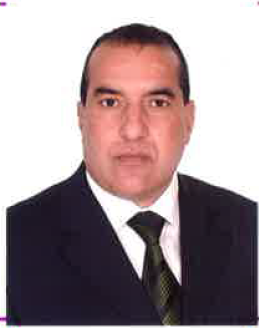
Djamel Benali

Journaliste, fondateur et directeur général d'Algérie Diplomatique Journaliste et membre fondateur de l'hebdomadaire Al-Shorouk Al-Arabi 1991-1994 Correspondant d'Al-Shorouk à Washington 1997 Journaliste spécialiste chargé des dialogues politiques 2002 Rejoint la télévision publique algérienne - Enquêteur - Monteur 2003-2013, Rédacteur en chef d'une émission à la une, producteur et animateur d'une émission dans le contexte 2009-2011 Rédacteur en chef central des émissions spécialisées et des grands reportages 2009-2014 Producteur de talk-shows Rencontre hebdomadaire pour la télévision algérienne Journaliste chargé des dialogues politiques et diplomatiques 2014-2019 Membre fondateur de Desire News Channel et rédacteur en chef central des émissions spécialisées et des grands reportages 2016-2018 Directeur des Programmes Spécialisés et des Grands Reportages chez Al Shorouk News Channel 2016 Fondateur et directeur général du site d'information algérien Diplomatic en arabe et en français 2020-2021 Directeur et fondateur du nouveau site d'information de la télévision algérienne, producteur et présentateur de programmes (Dibergtg) 2021 affecté à une mission auprès du directeur général de la télévision algérienne. Collaborateur de plusieurs journaux nationaux et arabes. Message de l'Atlas, Voix du Libre - Echo des stades - Ecrivain arabe - Correspondant de la télévision Al-Sa'a d'Algérie - représentant littéraire de Mme Anissa Boumediene, veuve de feu le Président Houari Boumediene 1994-1996 : Conseiller média du champion du monde et olympique Noureddine Morsli de 1993 à 2000. Auteurs : Auteur de 'Témoins et Bilan', présenté par Abdel Hamid Mahri. Dr Talib Ibrahimi Livres imprimés : avant la conversation. Entrevues télévisées.

Articles similaires

Laisser un commentaire

Votre adresse e-mail ne sera pas publiée. Les champs obligatoires sont indiqués avec *

quatre − un =

Bouton retour en haut de la page