
The Silk Road Initiative: How China Is Reshaping the Global Economy Through Development and Culture

By:djamel benali
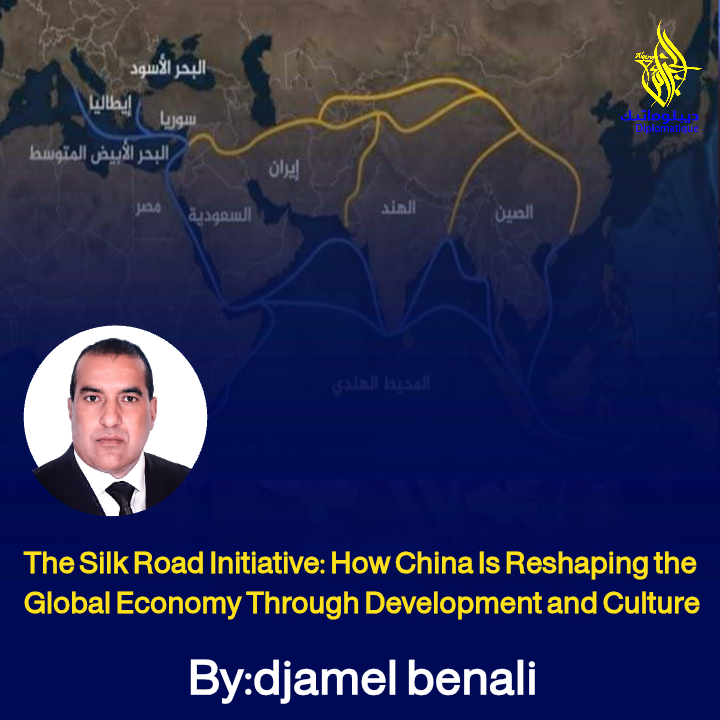
In a world marked by rapid geopolitical and economic transformations, China has emerged as one of the leading global powers that has chosen development and economic cooperation as its primary language of engagement with the international community. Through the Belt and Road Initiative (BRI), commonly known as the New Silk Road, Beijing has gone far beyond constructing ports, railways, highways, and industrial zones. It has introduced a comprehensive vision aimed at enhancing connectivity, promoting shared prosperity, and strengthening economic partnerships across Asia, Africa, Europe, and Latin America.
China’s remarkable economic transformation has demonstrated that sustainable development is not reserved for traditional industrial powers. Rather, it can be achieved through long-term strategic planning, massive investment in infrastructure, technological innovation, and openness to global cooperation. Today, the Belt and Road Initiative has become one of the most ambitious international development projects of the 21st century, bringing together dozens of countries under a shared vision of economic growth and mutual benefit.
Across many developing nations, Chinese investments have contributed to the construction of roads, bridges, railways, ports, power plants, and industrial parks. These projects have supported economic activity, improved infrastructure, generated employment opportunities, and, in some regions, strengthened food security and agricultural productivity. While the outcomes vary from one country to another depending on local conditions and policies, the initiative has provided many nations with new opportunities for long-term development and regional integration.
Beyond economics, China has increasingly invested in cultural diplomacy. Recognizing that lasting partnerships are built not only on trade but also on mutual understanding, Beijing has expanded academic exchanges, scholarship programs, cultural festivals, and language education initiatives. Chinese language learning has grown significantly worldwide, reflecting the country’s expanding economic influence and the increasing demand for professionals capable of engaging with one of the world’s largest economies.
China has also successfully promoted its rich civilization as an essential component of its soft power. With thousands of years of history, philosophy, art, and tradition, Chinese culture has become an important bridge connecting peoples and civilizations. In this sense, the New Silk Road is not merely a network for transporting goods; it is also a pathway for the exchange of ideas, knowledge, innovation, and cultural dialogue.
Although the Belt and Road Initiative continues to generate international debate regarding certain aspects of its implementation, its impact on the global economic landscape is undeniable. China has become a major economic partner for numerous countries, helping to develop strategic infrastructure and expand international trade while reinforcing its position as one of the world’s leading engines of growth.
The future will belong not only to nations with economic strength but also to those capable of building partnerships, encouraging innovation, respecting cultural diversity, and creating opportunities for shared prosperity. From this perspective, the New Silk Road represents far more than an infrastructure initiative—it embodies China’s aspiration to build a more interconnected world where development fosters stability, trade strengthens cooperation, and culture brings nations closer together.
Ultimately, China’s experience demonstrates that genuine global influence is measured not only by economic power but also by the ability to inspire development, promote cooperation, and create opportunities for a better future. This is the enduring vision of the Belt and Road Initiative: connecting continents, empowering societies, and building bridges of prosperity and mutual understanding.