Trump… Iran Shattered His Calculations and Pushed Him Back to Dialogue

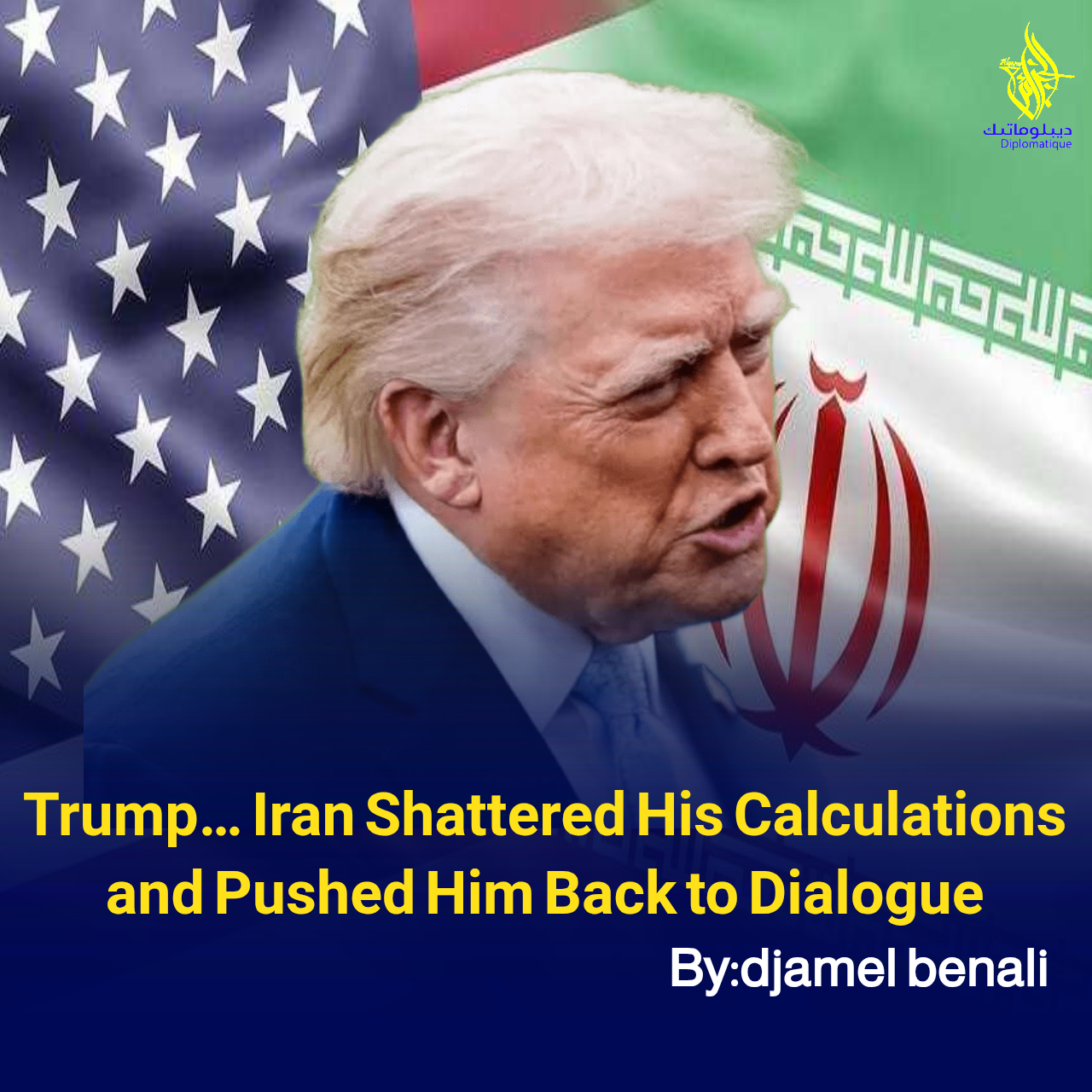
By:djamel benali
It was not in Donald Trump’s calculations that the balance of deterrence in the Middle East could shift so quickly, nor that his carefully crafted strategy would unravel into visible strategic confusion. He had wagered on a familiar script: a swift strike, a limited response, and internal pressure within Iran leading to political fracture—or at least weakening the system. What unfolded, however, defied every expectation.
Trump’s first miscalculation lay in underestimating Iran’s capacity to respond. He did not anticipate that Tehran would extend its reach toward U.S. bases in the region, turning them into potential targets within a new deterrence equation. The Iranian missile signals were not merely military—they were profoundly political: a clear assertion of presence and capability. In that moment, the assumption of uncontested dominance began to erode.
The second failure was a misreading of Iran’s internal cohesion. Trump had bet heavily on economic pressure and sanctions igniting widespread unrest against the system. Instead, external threats appeared to consolidate segments of the Iranian public around the notion of sovereignty. This relative unity undermined a central pillar of Washington’s strategy: leveraging internal dissent as a tool of pressure.
The third, and perhaps most consequential, misjudgment was about time. Iran was not expected to endure prolonged, multi-layered pressure—military, economic, and psychological. Yet its resilience transformed time itself from a weapon of coercion into an asset of resistance.
When Trump escalated his rhetoric, threatening to strike energy infrastructure and power generation facilities while issuing a 48-hour deadline, the situation seemed to edge toward a broader confrontation. But what followed exposed the limits of that escalation. The subsequent retreat was not merely tactical—it reflected a deeper realization that the cost of an open confrontation with Iran had been dangerously underestimated.
The logic of force collided with geopolitical realities. Iran is no easy target; its regional networks and missile capabilities make any large-scale military gamble highly risky. Moreover, targeting energy infrastructure would have jeopardized global oil market stability, potentially drawing major international actors into the crisis, even if indirectly.
Ultimately, Trump found himself facing two choices: escalate into uncertainty, or pivot toward dialogue. He chose the latter—reluctantly. Here lies the paradox: a leader who rose on a platform of confrontation was pushed toward negotiation, not from a position of absolute strength, but from one of recalibration.
What unfolded was not a fleeting episode of tension, but a revealing moment in the shifting balance of power. Iran demonstrated that deterrence is no longer monopolized by a single actor, and that modern conflicts are not decided by military power alone, but by resilience, strategic patience, and the ability to impose new equations on adversaries.
Between threats that never materialized and missiles that redrew red lines, Trump was confronted with an unexpected reality: the Middle East is no longer an open arena for unilateral decisions, and the era of striking without consequence has come to an end.