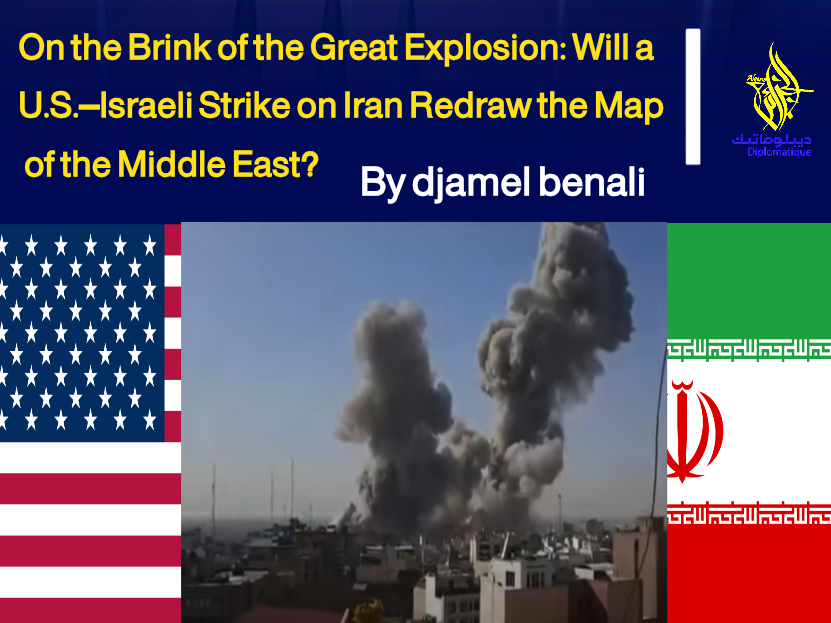
On the Brink of the Great Explosion: Will a U.S.–Israeli Strike on Iran Redraw the Map of the Middle East?

By djamel benali
The escalating tension between the United States and Israel on one side and Iran on the other cannot be understood merely through a narrow military lens. It must be viewed within a broader geopolitical framework involving the reshaping of regional balances of power, control over energy corridors, the restructuring of alliances, and the prevention of an emerging regional power operating outside Western strategic architecture.
The issue goes far beyond deterrence rhetoric; it is rooted in a long-term struggle over who defines the future order of the Middle East.
By.djamel benali
Since the withdrawal of the administration of Donald Trump from the 2015 nuclear agreement, formally known as the Joint Comprehensive Plan of Action, relations between Washington and Tehran entered a phase of “maximum pressure.” The nuclear file became not only a non-proliferation concern but also a strategic instrument aimed at containing Iran’s regional influence across Iraq, Syria, Lebanon, and Yemen. The objective extended beyond preventing a potential nuclear capability to recalibrating the entire regional power equation.
For Israel, Iran represents the primary strategic threat. Israeli security doctrine views Tehran not solely through the prism of its nuclear ambitions but also through its regional network of alliances and military entrenchment near Israel’s borders. Consequently, Israel has pursued a doctrine of preemptive containment, seeking to prevent Iranian military consolidation in Syria and elsewhere before it matures into a sustained strategic threat.
Geostrategically, Iran occupies a pivotal position. Overlooking the Strait of Hormuz—one of the world’s most critical energy chokepoints—it possesses leverage that extends beyond conventional military power.
Any large-scale confrontation risks disrupting global oil and gas supplies, raising energy prices, and destabilizing international markets. Furthermore, Iran’s regional reach provides it with operational depth, potentially transforming any direct conflict into a multi-front confrontation stretching across the Levant and the Gulf.
Meanwhile, Washington has sought to consolidate a new regional security architecture built on Arab–Israeli normalization and security cooperation, under American sponsorship. Within this framework, weakening Iran is perceived as a prerequisite for stabilizing a pro-Western alignment and guaranteeing Israel’s qualitative military edge, while integrating it more fully into the region’s economic and security systems.
Yet the balance of power is not unidirectional. Iran’s growing ties with major global actors, the Russian military presence in Syria, and the complex political landscapes of Iraq, Lebanon, and Yemen make any comprehensive military campaign a high-risk endeavor. Thus, the prevailing strategy appears to be one of “war without war”: limited strikes, intelligence operations, economic sanctions, and cyber warfare—carefully calibrated to avoid a full-scale conventional confrontation.
The central question, therefore, is not whether escalation is possible, but whether a major strike would truly reshape the Middle East according to a U.S.–Israeli vision, or instead unleash a strategic upheaval with unpredictable consequences. The region stands today on the edge of this uncertainty—between deterrence and explosion—where a single miscalculation could ignite a transformative moment in its modern history.