The Emirates of Evil: When Money Becomes a Tool of Betrayal and Destruction

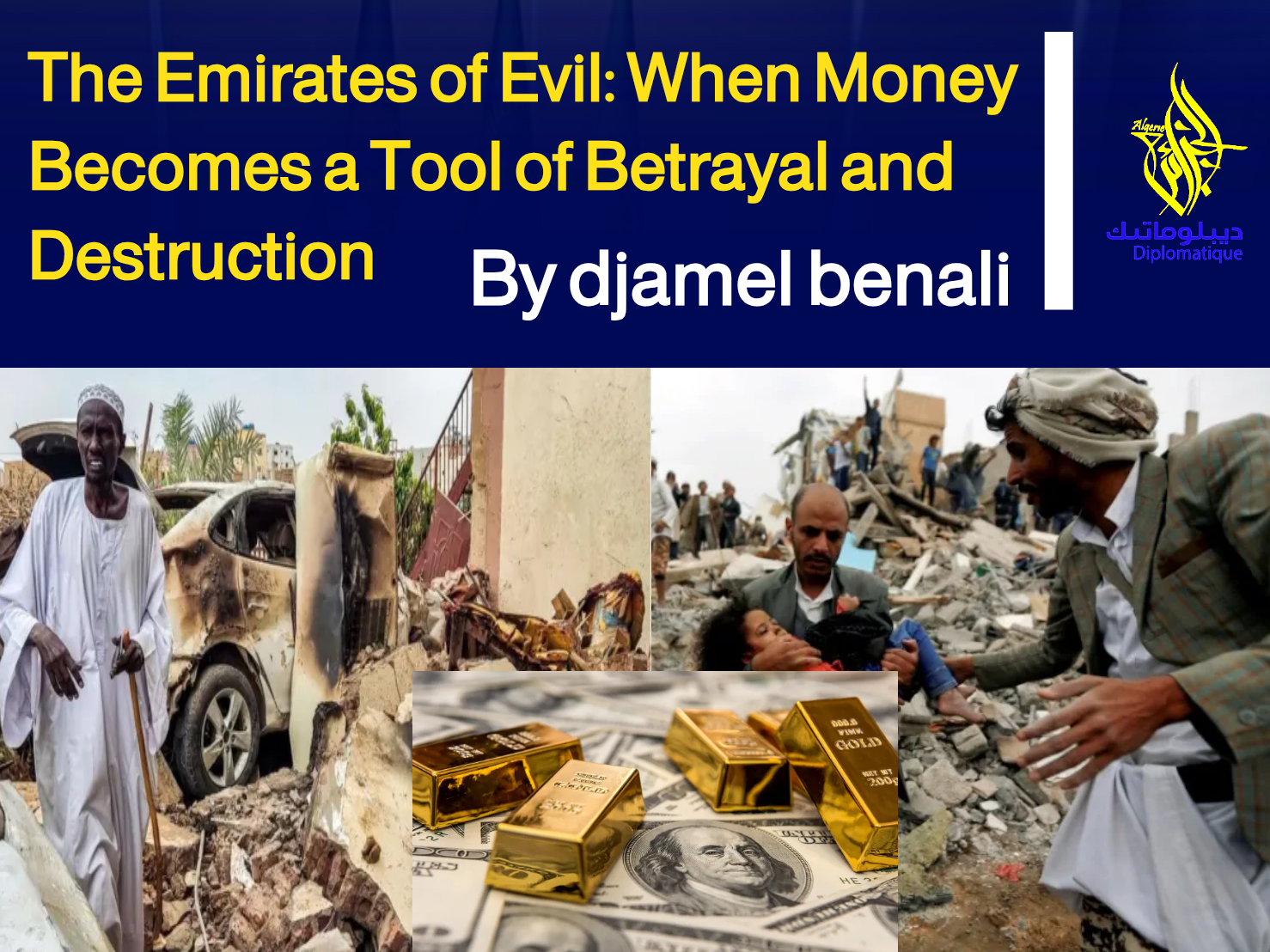
By djamel benali
In an age of major collapses, wars are no longer fought solely with tanks and fighter jets. They are waged with money when it is transformed into an instrument of betrayal, with “investment” when it becomes a cover for destruction, and with alliances when they are directed against the identity of nations and the interests of their peoples. Within this dark landscape, the role of the United Arab Emirates emerges not as that of a normal regional actor, but as a central hub in engineering chaos across the Arab and African worlds, in troubling alignment with the Zionist project and its political, security, and financial networks.
Emirati foreign policy is no longer conducted according to the logic of a sovereign state, but rather according to the logic of a regional function. A function based on buying loyalties, financing internal divisions, and fueling endless conflicts in service of redrawing the region through fragmentation rather than stability. Emirati money, promoted internationally as a tool for development, has in multiple arenas turned into a means of pressure, manipulation, and systematic sabotage, where sovereignty is replaced by dependency, the state by militias, and national interest by external agendas.
In Sudan, this role is exposed with striking clarity. Sudanese gold, particularly from conflict zones, has not merely been a natural resource, but fuel for war, smuggled and used to finance armed networks outside state institutions. Interference in internal power balances and support for specific armed actors have contributed directly to the dismantling of the state and the prolongation of conflict. This trajectory objectively converges with Zionist interests aimed at weakening Sudan as a strategic Arab and African depth.
In Yemen, slogans of coalition and restoring legitimacy were loudly raised, yet the outcome was a shattered state and a geography divided into zones of influence. The backing of militias, control over ports and islands, and the transformation of Yemeni coasts into regional leverage points all took place at the expense of Yemeni unity and sovereignty. The practical result has been the positioning of one of the world’s most vital maritime corridors within a framework that serves Zionist security interests far more than the Yemeni people.
Libya, in turn, became a testing ground for Emirati money and weapons. Rather than supporting a unified state and its institutions, resources were poured into chaos, financing military and political projects that deepened division and paralyzed any national political process. Oil rich Libya was deliberately kept hostage to conflict, because a strong and independent Libyan state does not serve domination, nor does it fit within projects of external tutelage.
This same pattern extends into the African Sahel, where fragile states intersect with immense reserves of gold and rare minerals. There, the Emirati role appears through investment fronts and private security companies, yet the reality points to organized plunder of wealth and the indirect fueling of instability. In this arena, Emirati capital converges with Zionist expertise in managing conflicts, transforming disorder into a permanent source of influence and profit.
What unites all these theaters is not coincidence, but a single consistent pattern: weakening national states, dismantling armies, tearing apart social fabrics, and converting political crises into prolonged internal wars. It is an alliance of money with the enemy, where certain Arab capitals function as operational tools for projects that serve only the supremacy of the Zionist entity and the perpetual exhaustion of the region.
When money becomes an instrument of betrayal, and when wealth is directed against peoples rather than for their benefit, all masks inevitably fall. What is unfolding today is not a series of policy mistakes, but a deliberate strategic choice rooted in systematic destruction. History does not forgive, and peoples do not forget. Those who wager on money against nations will ultimately discover that destruction creates no glory, only an enduring legacy of betrayal.